


You spent $40 on a good cut of beef, followed every step, and somehow ended up with something you can't even chew enough to swallow.
Sound familiar?
What Every Recipe Leaves Out
Sometimes, jerky recipes hand you an ingredient list, tell you to dehydrate for a few hours, and then disappear when your batch turns out wrong. They can skip the slice angle, the dry time, the sugar confusion, the safety guesswork, the variables that decide whether it works.
Here's the thing: a beef jerky recipe is only about 30% of the equation. The other 70% is technique.
Slicing direction, thickness consistency, marinade penetration, drying humidity, and how you define "done" can matter more than whether you used mesquite or teriyaki seasoning. That's why your friend swears by the exact recipe you tried and failed with. The recipe was fine. The variables weren't.
Skip the experiment. The Beef Jerky Mega Pack gets you all five Mythical Meats flavors in one box, no thermometer required.
The 5 Variables That Control Jerky
Cut direction. Slicing with the grain makes jerky chewier and tougher. Against the grain makes it easier to bite. Neither is wrong, just be intentional.
Thickness. Consistency matters more than the exact number. Aim for strips around 1/4 inch, and partially freeze the meat for 1 to 2 hours first, it makes even slicing dramatically easier.
Marinade time. Under 4 hours and you're just coating the surface. Over 24 hours and the acid starts breaking down texture. Most beef jerky recipes land best between 6 and 12 hours, fully submerged.
Drying temperature and time. Too hot and you're cooking, not dehydrating. Too low and you're inviting bacteria. Your kitchen's humidity affects the timeline more than any recipe can predict, which is why your friend's "3 hour recipe" might take you 4.5.
The "done" test. Jerky is ready when it bends and cracks without snapping, with white muscle fibers just starting to show. Snaps clean? Too far. Bends like rubber? Not done yet.
Best Cut for Jerky
Eye of round, top round, bottom round, London broil, and flank steak are the go-to cuts, all lean, and all take a marinade well. Eye of round is the most popular: affordable, evenly shaped, easy to slice consistently.
Whichever you pick, trim all visible fat and silver skin first. Fat doesn't dehydrate, it goes rancid, and that's the fastest way to ruin an otherwise good batch.
Why Your Jerky Is Tough
Tough jerky almost always comes down to one of three things: you sliced with the grain instead of against it, you dried it past pliable (heat tightens the proteins, and the meat keeps firming as it cools, so pull it early), or the marinade never fully penetrated a lean cut like eye of round.
A less common fourth culprit is case hardening: the surface dries too fast and traps moisture inside, so it looks done but stays wet in the middle. Lower the temperature slightly and make sure air can circulate to avoid it.
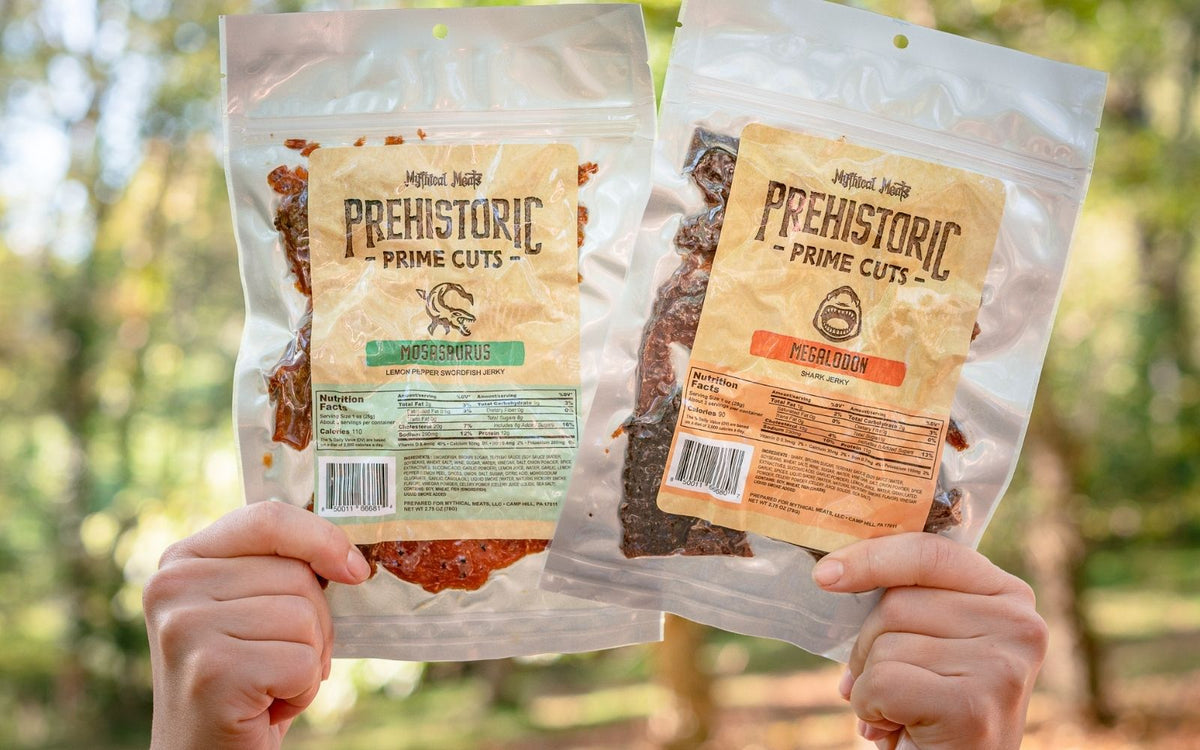
Rather taste it than troubleshoot it? Prehistoric Prime Cuts is already dialed in, teriyaki-marinated wild boar, shark, turtle, and swordfish for the adventurous eater.
What Went Wrong With Your Last Batch?
Match your symptom to the fix below.
| Symptom | What happened | Fix |
|---|---|---|
| Snapped clean in half | Over-dried | Pull your next batch 30 to 60 minutes earlier and check more often near the end. It should bend and crack, not snap. |
| Chewy and stringy | Sliced with the grain | Rotate the cut 90 degrees and slice against the grain next time for a cleaner bite. |
| Tough but not dry | Marinade didn't do its job | Increase your soak time and add an acidic component like citrus or vinegar to help tenderize the meat. |
| Soft and tacky | Under-dried | Put it back in and check in 30-minute increments until the surface is dry to the touch. |
| Uneven texture | Inconsistent slicing | Partially freeze the meat next time and use a sharp knife or meat slicer to keep every strip close to the same thickness. |
| Bland flavor | Marinade didn't penetrate deep enough | Score the meat lightly before soaking and extend the marination to 8 to 12 hours. |
The Sugar Question No One Explains Clearly
Sugar in jerky is a flashpoint online. Keto forums treat it like poison, BBQ purists call it essential. In reality, sugar balances flavor, helps browning, and adds a bit of glaze. Skip it and your jerky still dries fine, just slightly more one-note.
Store-bought jerky often runs 5 to 10 grams of sugar per serving. Small-batch brands that lean on real hardwood smoke instead of shortcuts tend to run well under that, worth checking the label for.
Jerky Marinade Basics Worth Knowing
A lot of marinades share the same base: soy sauce, Worcestershire sauce, black pepper, garlic powder, and onion powder. Customize from there, cayenne for heat, smoked paprika or a touch of liquid smoke if you don't have a smoker.
What matters more than the ingredients is contact time. Flip or stir every few hours, use a zip-lock bag with the air pressed out rather than a shallow dish, and pat the strips dry before drying. That last step alone prevents a lot of case hardening.
Making Jerky Safely
The USDA recommends bringing the meat to 160°F (71°C) at some point before or during drying, the one non-negotiable step, since pathogens like E. coli and Salmonella can survive standard dehydrator temperatures otherwise.
Some dehydrators don't reliably hit that mark, which is why many home jerky makers preheat strips in the oven or boil the marinade with the meat first. Use a digital meat thermometer to check actual meat temperature, not just the dehydrator's air-temp dial.
Once dried, store jerky in an airtight container or vacuum-sealed bag: 1 to 2 weeks at room temperature, 1 to 2 months refrigerated. If you're unsure whether it's dry enough, refrigerate it.
Curing salt (Prague Powder #1) isn't required if you're hitting proper temperatures and eating it within that window, but it adds a margin of safety for long-term storage or gifting. Mold, off smells, or a slimy texture mean toss the batch, no exceptions.
Oven vs. Dehydrator vs. Smoker
| Method | Best for | Tradeoff |
|---|---|---|
| Oven | Most accessible, no extra gear | Uneven airflow, kitchen smells like jerky for two days |
| Dehydrator | Most control, consistent heat | $40 to $80 to buy, verify it actually hits 160°F |
| Smoker | Richest flavor, real hardwood smoke | Takes the most time and attention |
| Ground beef (jerky gun) | Fastest, cheapest per batch | Texture closer to a meat stick than a strip |
You can ruin jerky in a $400 smoker as easily as a $40 dehydrator. Consistent slicing and hitting the right temperature matter more than the equipment.
Is Homemade Jerky Worth It?
Making jerky at home is a genuine craft project. You control every ingredient and can experiment with venison, turkey, or whatever protein interests you.
But it's not cheap or fast: a pound of beef yields about 6 to 8 ounces of finished jerky, and between the meat, marinade, and 12 to 24 hours of prep and drying, you're often looking at $3 to $5 per ounce, before counting your time.
It's worth doing if you like the process. It's a harder sell if you just want a reliable snack you can grab and go.
Want the flavor without losing your afternoon? Shop the beef jerky lineup, or feed a table for game night with the meat stick variety packs, including the D&D Adventurer's Rations.
Quick Diagnostic Checklist
Before you start: meat partially frozen, slicing against the grain, strips a consistent 1/4 inch, all visible fat trimmed.
During: at least 6 hours marinating with full contact, internal temp hitting 160°F at some point, strips spaced apart so air can circulate.
Done test: bends and cracks without snapping, dry to the touch with no tackiness.
Get these right and your jerky recipe, whichever one you use, will deliver what it promised.
Frequently Asked Questions
Q: What temperature kills bacteria in homemade jerky?
A: The USDA recommends heating meat to 160°F (71°C) at some point before or during drying. That's an internal meat temperature, not just the dehydrator's air temperature, so verify it with a digital meat thermometer rather than trusting the dial.
Q: Do I need curing salt to make jerky at home?
A: Not if you hit proper drying temperatures and eat it within a reasonable window. Curing salt like Prague Powder #1 adds a margin of safety mainly useful for long-term storage or gifting batches.
Q: What's the best cut of meat for jerky?
A: Eye of round, top round, bottom round, London broil, and flank steak are the most common choices. Eye of round is the most popular since it's lean, affordable, and slices into consistent strips.
Q: How long does homemade jerky last?
A: About 1 to 2 weeks at room temperature in an airtight container, or 1 to 2 months refrigerated. If you're unsure whether it dried enough, refrigerate it rather than risk it.
Q: Is homemade jerky cheaper than store-bought?
A: Not usually. A pound of beef yields about 6 to 8 ounces of finished jerky, and by the time you account for the meat, marinade, and 12 to 24 hours of prep and drying time, homemade often costs more per ounce than a quality small-batch bag.
Keep Exploring
- Meat Stick Collection, 16 creatures, 37 flavors, our actual specialty.
Mythical Meats crafts premium exotic game snack sticks and hand-cut beef jerky in small batches in the USA. No MSG, no shortcuts.
References
1. fsis.usda.gov/food-safety/safe-food-handling-and-preparation/meat-fish/jerky