


Quick answer: Premium jerky is whole-muscle, hand-cut meat, with a short ingredient list and no MSG or artificial anything. "Premium" isn't a regulated word. Anyone can print it on a bag. The ingredient panel is what actually tells you the truth.
Nobody hates jerky. People hate the specific bag they bought last time. The one that chewed like a shoelace, or cost twelve dollars and tasted like a campfire that never happened.
That's a buying problem. Here's how to fix it.
"Premium" Is a Word, Not a Standard
Any brand can put "premium beef jerky" on a bag. There's no rule against it. So the phrase alone tells you nothing, and you have to go find the signal yourself.
The Cut
Real beef jerky is hand-sliced from a whole muscle, a top round or an eye of round, something you could point to on a butcher's chart. A lot of what's on shelves is ground meat pressed into strips and dried instead.
Not a worse product, necessarily. Just a different one, and it shouldn't cost what the real thing costs. Hand-cut jerky almost always comes out of small batches too, since cutting it right takes longer than a machine running strips through a press.
The Ingredients
Flip the bag over first. A clean panel reads like something out of a kitchen: meat, salt, spices. When the list runs three lines and includes monosodium glutamate or a name you can't pronounce, the front of the bag is overselling what's on the back. Premium-quality jerky earns that word through what's in the bag, not what's printed on it.
Preservatives are a separate question from all of this. Some brands run with no preservatives at all, leaning on salt and drying alone. Others use a small amount to extend shelf life. Neither is automatically the better choice, just a different trade-off, and it's worth knowing which one you're buying.
The Chew
Underrated, and the easiest one to check yourself. Good jerky chews the same from the first piece to the last. Bad jerky gives you one tender strip and one you have to work at, because the batch got rushed through a dehydrator instead of watched.
Jerky and Meat Sticks Are Not the Same Thing
Jerky is hand-cut, whole-muscle meat. A meat stick is ground, seasoned meat in a casing, closer to a slim sausage than a slice of steak. People lump them together constantly, which is understandable, but they're different products with different standards behind them, and calling one the other muddies both.
If you're comparing "healthiest beef sticks" or asking whether beef sticks are gluten-free, that's a meat stick question, not a jerky one. We'll get to gluten in the FAQ below, since the honest answer is "it depends on the flavor," not a blanket yes.
What Mythical Meats Sells
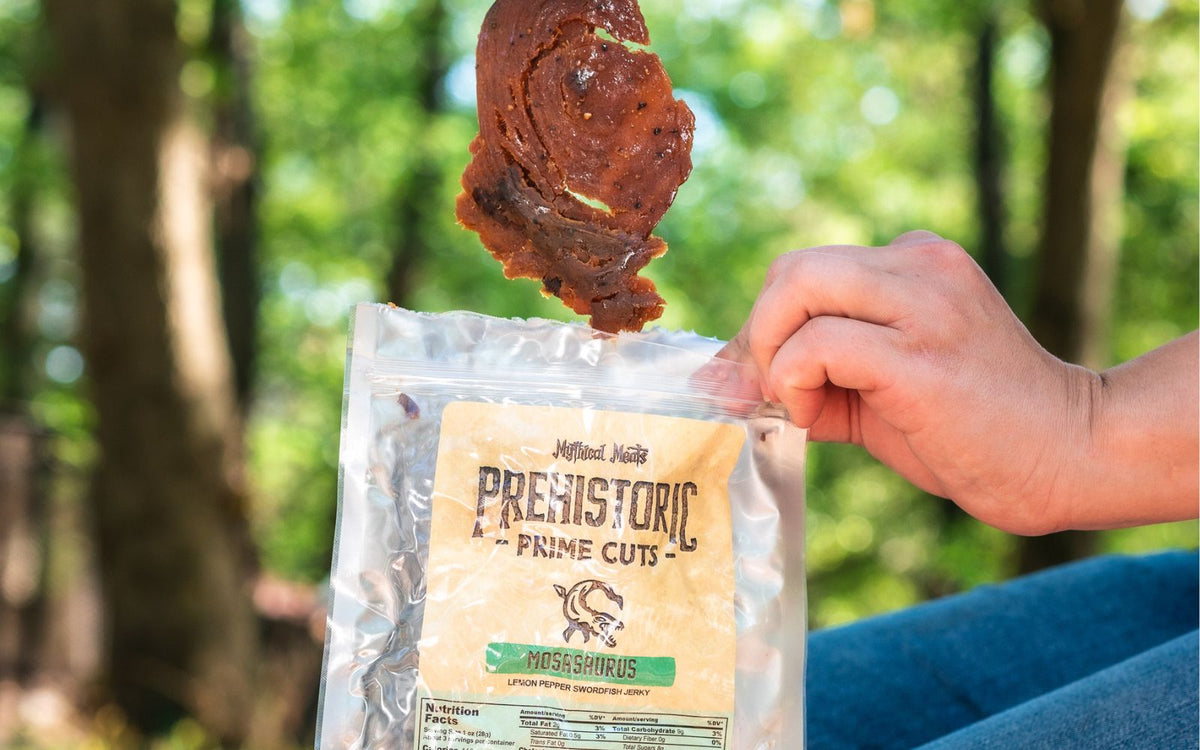
For the record, since it comes up: five hand-cut Beef Jerky flavors (Unicorn, Bigfoot, Dragon, Mermaid, Leprechaun) and four Prehistoric Prime Cuts exotic jerky flavors (Megalodon, Mosasaurus, Ankylosaurus, Wooly Mammoth).
Everything else, the wider snack stick lineup, is a separate product, not jerky: 37 flavors, 1 oz, individually wrapped, 5 to 12 grams of protein and under two grams of sugar per stick.
Five Ways People Waste Money on Jerky
Buying on Hype
A viral post tells you nothing about whether you'll like the bag on a Tuesday. Check the ingredients before you check the follower count.
Ignoring the Sugar Line
Teriyaki and honey glaze flavors can run 8 to 12 grams of sugar per serving, which is candy-bar territory in something people assume is a clean snack. Under 3 grams is fine. Under 1 gram is rare enough to be worth seeking out.
Assuming Price Equals Quality
Some brands charge a premium for average jerky in nice packaging. Others sell direct and skip the retail markup entirely. Cost per ounce, not the sticker price, is the number that actually means something.
Going Full-Size on an Untested Flavor
This is how bags end up forgotten in the pantry. A variety pack solves this before you commit to a full bag, whatever brand it is.
Ignoring the Occasion
Jerky for a road trip, jerky as a gift, and jerky for a game night are three different purchases, even though they're technically the same product.
What the Exotic Stuff Tastes Like
If you've only had beef jerky, you've had about a quarter of what's out there.
Wild boar runs bold and a little sweet, and holds up well against a teriyaki base. Shark and swordfish are soft and flakey, closer to a white fish than anything gamey. Snapping turtle is the one most people order out of pure curiosity, and it's usually the one that converts them.
Heat runs a real spectrum too, from black pepper on the mild end up through ghost pepper and Carolina Reaper territory. A good spicy jerky builds through that range instead of front-loading heat and calling it done.
Reading a Label Without a Nutrition Degree
Ingredients are listed by weight, so the first item is the biggest part of what's in the bag. A named cut of meat up front is a good sign. The word "meat" by itself is not.
Protein
8 to 15 grams per serving is what makes something a genuinely high protein snack. Our beef jerky runs from 10-12 grams per serving.
Sugar
The number matters less on its own than whether it matches the flavor. Across our five beef jerky flavors, sugar runs 2 to 17 grams per serving depending which one you pick, tracking how sweet or savory that specific flavor is built to be.
Anyone who is watching their sugar intake should always check the label.
Sodium
300 to 500 mg is typical. It's a preservation thing, so it's always going to be there. Past 600 mg it starts adding up fast, especially if you eat more than the listed serving, which most people do. Mythical Meats jerky runs anywhere from 330-390 mg.
A Note on Curing Agents
Nitrates and nitrites show up on some brands' labels as curing agents, standard in a lot of cured meat generally. They're not automatically a red flag the way MSG or artificial dyes are, but if you're tracking them, the ingredient panel is where you'll find them, not the front of the bag.
Where to Buy It
Direct from the brand's own site, almost always. Fresher stock, the full flavor range, and the occasional limited run that never sees a shelf. It's usually cheaper too, once you factor out the retailer markup.
Independent and specialty shops are worth checking, particularly for brands you won't see at a chain. That's usually where a small operation's full flavor range actually lives, since a lot of it never makes it to a big-box shelf.
Marketplaces are fine for discovery, just check the date. Grocery shelf space goes to whoever can supply volume, and that's rarely the small-batch producer, so what's on the shelf is a filtered selection, not the full picture.
Jerky as a Gift
Good gift for someone hard to shop for. Unexpected, consumable, low risk, as long as you don't guess wrong on flavor.
Which is the whole case for a sampler over a full bag: it gets the person the full flavor range in one gift instead of a bet on a single one. If you're shopping for someone more into the gaming and fantasy side of things, know whether you're buying them a jerky gift or a meat stick gift specifically. They're not interchangeable, and a purist will notice.
Most direct-to-consumer jerky brands back orders with some version of a money-back guarantee. Worth checking before you buy one as a gift, since it takes some of the risk out of guessing wrong.
Keeping It Fresh Once You've Opened It
Unopened, jerky holds for 6 to 12 months in a cool, dry, dark spot, though it tastes best earlier in that window. Opened, push the air out, reseal tight, and eat it within a week at room temperature. Refrigerate for another week or two. Freezing works but can change the texture a bit.
A white, dusty film on the surface is fat bloom, not spoilage. Normal, safe, nothing to worry about. If it's fuzzy or slimy or smells off, that's mold, and there's no gray area there: throw it out.
The Five-Question Gut Check
There's no single best beef jerky, just the best one for what you're actually after. Think of this as the gear check before you head out. Five questions, then you're set.
What protein do you want? Beef for reliability, something exotic if you're in the mood for it.
What texture? Tender, balanced, or old-fashioned dry. Balanced if you're not sure.
How clean does the ingredient list need to be? If no MSG and no artificial anything matters to you, that's the first thing to check, not the last.
What's the occasion? Personal snacking, a gift, or a shared table. Pick the format that fits.
Are you willing to try something new? If yes, sample first. It's the cheapest way to find out what you actually like before you buy a full bag of it.
Frequently Asked Questions
Is premium jerky worth the extra cost?
When the brand can point to specifics, whole-muscle cuts, a short ingredient list, small-batch production, yes. If they can't name those specifics, you're probably paying for the bag design more than what's inside it.
What's the healthiest premium jerky?
8 to 15 grams of protein per serving, under 3 grams of sugar, sodium under 500 mg, no MSG, no artificial preservatives. The ingredient panel tells you more about health than the protein source does.
How long does premium jerky last?
6 to 12 months unopened in a cool, dry place. Once opened, 3 to 7 days at room temperature, about two weeks refrigerated. Freezing extends it further but softens the texture slightly.
What's the best jerky for gifting?
A sampler that spans the brand's range, packaged well, beats a bet on one flavor. That's the whole logic behind buying a variety pack as a gift instead of a single bag.
Is Mythical Meats jerky or snack sticks gluten-free?
Depends on the specific product. Our Original Variety Pack snack sticks are entirely gluten-free. Our Werewolf, Mermaid, and Cleric snack sticks contain wheat. On the jerky side, every Beef Jerky flavor contains soy, and the 6 oz bags also contain wheat.
Prehistoric Prime Cuts contains wheat, soy, and celery. One thing worth knowing: "Mermaid" is a flavor name we use in both the snack stick line and the jerky line, with different recipes behind each. Check the individual label, not just the name.
How is exotic jerky different from regular beef jerky?
The protein itself tastes and chews differently. Wild boar runs bold and a little sweet. Shark and swordfish are firmer and meatier than most people expect. That's a real enough difference that it's worth treating as its own category instead of folding it into regular beef jerky.
Can jerky work as a high-protein snack for fitness?
Yes, and it's one of the most convenient options out there: no prep, shelf-stable before opening, and naturally keto friendly since carbs stay low across most of the category. Watch the sugar and sodium if you're eating it daily. Those two add up faster than the protein number makes you think.
Where to Start
Start with the Mega Pack if you want to try all five, Unicorn to Leprechaun, at once, or go straight to Prehistoric Prime Cuts for wild boar, shark, snapping turtle, and swordfish under names like Megalodon and Mosasaurus. Check the panel on whichever one you land on, not just the name on the front.
Full lineup: shop.mythicalmeats.com
References
- pmc.ncbi.nlm.nih.gov/articles/PMC5694874